RULES AND GUIDELINES
The rules and guidelines are designed to create a fun, fair and safe environment for learning about robotics in a combat bot format. Creating a standardized bot that everyone starts from creates a balanced playing field. The idea is to create a robot that is “standardized” that can be customized to fit the needs of that combat bot. The following rules have been constructed to be as unrestrictive to the design process as possible while balancing fairness to other competitors, arena damage, event-scheduling issues, and the safety of all competitors, crew, and audience members. Nothing contained herein shall be construed as an official invitation to join and/or compete in Rreal Ridgecrest Robotics Education and Learning. Rreal must approve and accept your bot’s design for the Tournament or any meetings or activities where operations of the bots is conducted for Rreal events. If your bot was accepted by Rreal for use in any prior event, tournament or any other hosted venues, that does not guarantee that the same bot will be accepted for use in this Tournament. Regardless of how you may interpret these rules, Rreal officials have the final authority of whether your bot design will be allowed to be entered. If you have any questions about the legality of any bot you are planning to build, contact Rreal with detailed explanations and/or drawings prior to starting construction. Likewise, if you plan to make any significant changes to your design during or after construction, check with Rreal before making your changes.
Bot Basics:
A. Your bot can potentially be a walker, roller, hopper, slitherer, as long as it moves around in a controlled manner without causing damage to the arena. At a minimum, we would like your bot to be able to move around at a fast walk (3mph). No flying bots are allowed at this time.
B. You must have reliable remote control over all of your bot’s functions and positions. Autonomous functions in the bot are acceptable, provided you are able to remotely disable or override those functions at any time.
C. Configuration A bot can actually be comprised of two or more “micro/multi bots”. Each Multi-Bot must meet all of the design requirements listed under micro-bots described in this document. And of course, the total weight of all the bots cannot exceed the limit set forth in the Weight Limits section.
D. Bots that use locomotion methods other than wheel or tracks will be allowed a 10% weight increase allowance.
Robot Build Guide:
Weight limits:
Robot weight is limited to 1lb or 453.5g
Robots over 453.59g are not permitted
Size Limits
Robots must fit in the space provided and cannot exceed 12'‘x12”x 12” or .3mx.3mx.3m
Materials:
Robot chassis can be made from the following : PLA, PTEG, ABS, TPU/TPE, and CF(carbon fiber) or wood infused versions of the previously listed materials, wood
Weapons materials must be from the following list : PLA, PTEG, ABS, TPU/TPE, and CF(carbon fiber) or wood infused versions of the previously listed materials , wood
Epoxy, glues, tapes and other bonding agents are permitted to build a robot but are not permitted as a replacement or reinforcement of the body/weapons. Example: gluing a spike onto the body as a weapon is allowed but coating the entire sidewall of the robot is not allowed
Internal electronics are permitted including batteries, esc(electronic speed controllers), leds/lights, fans for cooling, receivers. Included with this is connectors, solder, heat shrink and appropriate/safe means for connecting these devices
Prohibited Materials:
Radioactive materials.
Hazardous loose fibers (asbestos, etc.). Carbon or fiberglass composites are OK.
Toxic or reactive metals (e.g., Cadmium, Mercury, Lithium), except in batteries.
Organic substances (except wood, wood products and battery electrolytes).
Polyurethane foam
Lead metal (Pb)
Rigid plastic foams (PVC, Styrofoam, etc.)
Foam rubber used for armor or decoration
Glass or brittle ceramics
Weapons:
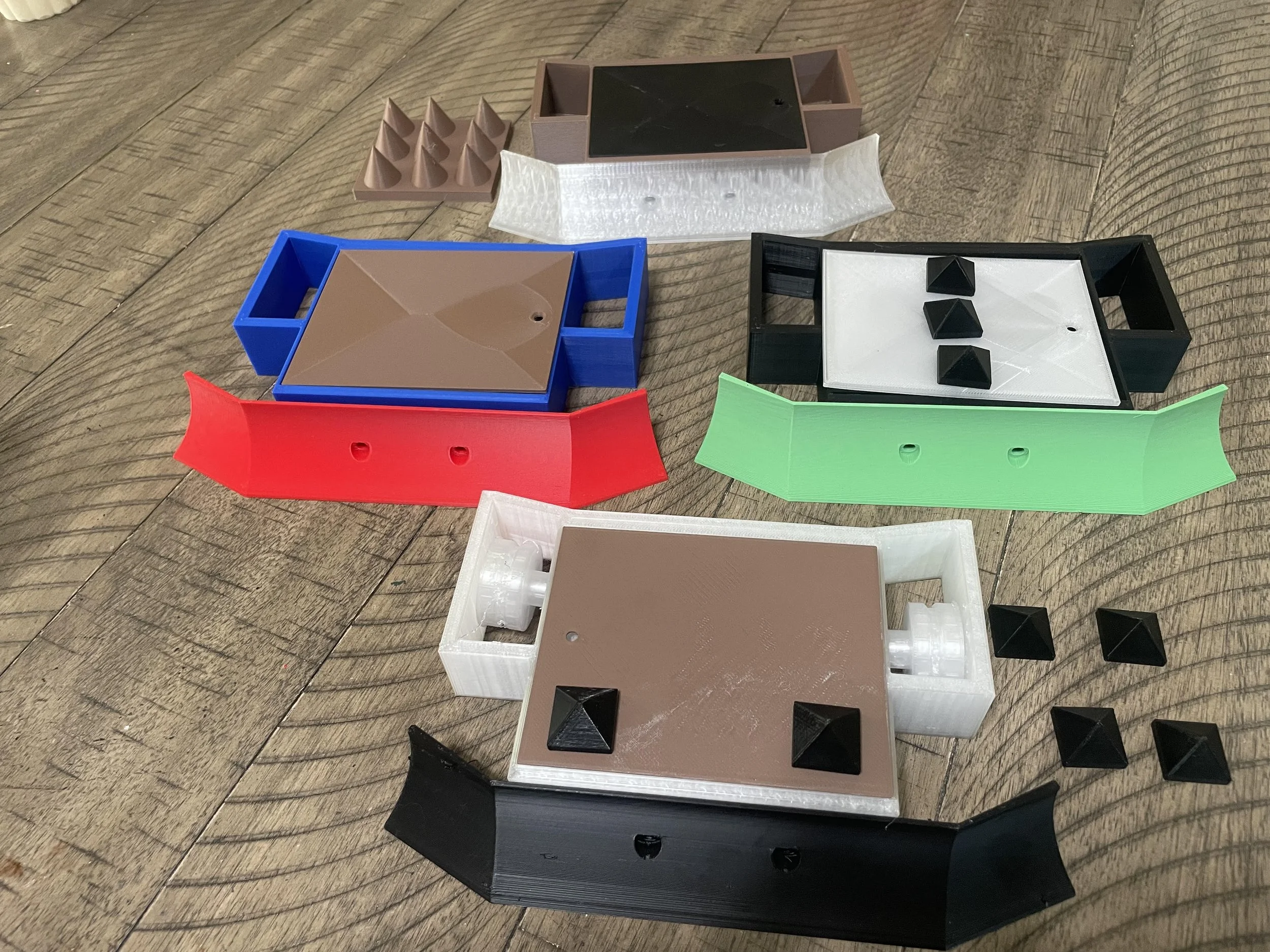
Weapons allowed include: push style scoops, ramps or wedges, pushers, articulated swinging weapons that move in one plane in a back and forth motion(eg. hammers and axes), claws or grabbers, spikes or protruding ridged objects, lifters/flippers, crushers
Wheels and mobility devices are not considered weapons
Weapons materials listed must be 100% of the contact surface that could interact with other robots (excluding damage that exposes internal parts) : PLA, PTEG, ABS, TPU/TPE, and CF(carbon fiber) or wood infused versions of the previously listed materials
Unapproved weapons
Spinning disks, drills, flames/flamethrowers, projectile
Fouling devices such as glue, nets, fishing line, ball bearings and such.
Squirting liquids or liquefied gasses such as liquid Nitrogen.
EMP generators or other means intended to damage or jam the opponent bot’s electronics.
Deliberate smoke generators.
Bright lights, lasers, etc., that are distracting or dangerous to vision.
Weapons that damage the other bot by destroying themselves.
Pnuematics and Hydrolics:
Must be approved before use.
Micro/multi bots:
Multiple bots with micro bots are allowed. Up to two micro bots are allowed in addition to your main bot.
The micro bots in addition to the main bot must not exceed the 1lb weight limit. The micro bot/bots can not exceed 1/3 the total weight of the 1lb weight limit.
Micro/multi bots that have weapons must be controlled via remote control functionality. Micro bots that do not have a moving weapon(example micro wedge bots) can be autonomous as long as they have a remote kill function to stop the bot at any time.
Indicator lights:
All combat bots are required to have a light, or combination of lights, that indicate if any electrical power is going to the bot or any of the bot’s weapon, mobility, self-righting systems. All lights must operate automatically when a Master Switch is turned on. The lights can be any color, but must be sufficiently bright and located such that their illumination can be readily seen by the bot’s operators and any person in close proximity to the bot. A light is not required to indicate if power is going to a remote-control receiver.
Deactivation:
When your bot is deactivated, it must be incapable of moving or of operating any of its weapons. Deactivation cannot require more than 30 seconds. If the bot has just been seriously damaged in combat, the deactivation time requirement may be waived for that match, but the bot must be otherwise rendered safe before removing it from the arena.
Remote Control:
All communications to or from bots must use a commercially available remote control (“RC”) system that uses a form of Digital Spread Spectrum (“DSS”) communication with automatic pairing between the transmitter and receiver. There are many systems and conversions available. A good commercial DSS system is virtually immune to interference. It is your responsibility to confirm that your RC equipment cannot interfere with any other RC system operating on the same frequency. Your control systems have to be designed such that if your transmitter(s) lose power or are turned off, your bot and its weapon(s) will stop moving. We will verify your system at the Tournament. If your RC system interferes with other systems at the Tournament, you may be disqualified. You may also be disqualified if you can’t demonstrate that your RC system provides reliable, positive control in the arena. If you have elaborate RC communication station equipment, you will have 60 seconds to set it up and 60 seconds to remove it.
Design and regulatory parts:
Motors must be n20 with a max of 110rpm
Batteries for bots must be Lipo(Lithium Polymer) and have no signs of damage including but not limited to swelling, nicks, cuts, crush damage, holes, frayed wires. ***Micro bots may use cylindrical LiFe, NiMh or NiCad or Lithium Polymer batteries***
Wheels must be a comprised of one or more of the following : Rubber, wood, PLA, PTEG, ABS, TPU/TPE, and CF/wood infused versions of previously listed materials
Provided stl for chassis from (Robot league name here) must be used with a less than 20% removal of materials from the original file. Adding materials is permitted.